

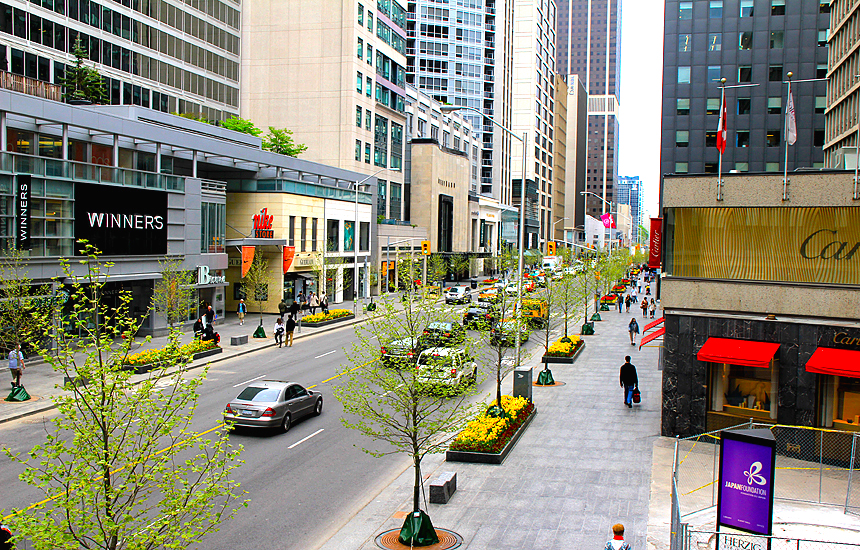
Photo: androiduk, Urban Toronto
By Nima Ghodratpour
There have been a significant number of new international retailers coming to Canada. These include brands which are shifting from wholesale distribution and shop-in-shops, to company-operated stores — a trend that is increasingly being adopted by luxury brands. These brands also include newcomers currently in global expansion mode, who see Canada as an attractive and potentially profitable market.

A study by CBRE examined the saturation of 280 global retailers (mass and luxury), and came up with the contents of Table 1.1, to the right. The table yields two revelations: the first, that the United States is not at the very top of the list, and the fact that Spain and Germany seem to be better destinations for global retailers. The second, is that Canada is currently home to only 37% of the 280 global retailers.
The low saturation rate in Canada can actually be seen as a strength, pointing to the immense un-tapped potential of the Canadian retail market, relative to other global destinations. Indeed walking through some of Canada’s malls and shopping destinations, one will quickly be overcome by the countless hoardings, heralding the Opening Soon of a new brand or store.
So why are global retailers increasingly deciding to come to Canada?
There is a great deal of data that goes into a location’s Trade Area Analysis to determine the viability of a location. Zone purchasing power, store saturation measure, net trade adequacy and various geographical considerations (indexes for which Canada scores very high). are all important. There is another factor that is also of absolute importance when making a decision to open a store — rent. Canada’s reasonable rents, compared to other international countries, make Canadian cities highly competitive locations for expansion.
Why is rent important?
Prior to opening a business, retailers look at what their potential costs would be in a given location, and match those costs to projected sales. This is known as doing a ‘break-even analysis’. A store breaks even when gross margin from sales is equal to the fixed costs needed to produce those sales. Forecasting potential sales is purely speculative. Retailers have much more concrete figures when looking at costs. The following scenario works to illustrate this concept. When a brand wants to set up their first store, the inclination is to look at a sizable piece of real estate in a prime retail location. Let’s consider this in a hypothetical situation, focusing on luxury retail.
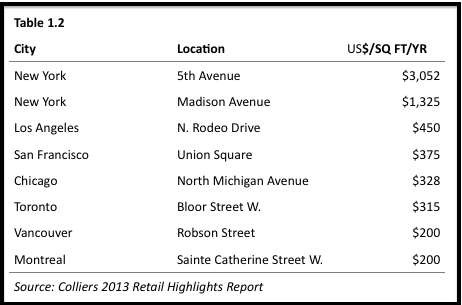
In this scenario, we will look at 4,000 square foot store on the fashionable Avenue Montaigne in Paris. Rent usually accounts for 10-20% of total sales, and usually is the largest fixed cost of any retail business. The average rent for such a location would be around $1,430 per square foot per year. The rent would therefore be just under $6 million per year. Sales staff cost, for eight people, would be just under $600,000 per year, including miscellaneous fixed costs. The store would therefore have fixed costs in the order of $6.6 million per year. Using a standard gross margin of 50 percent, this store would need sales of roughly $13.2 million a year just to break even. Can a store achieve that level of sales? If not, then it’s back to the drawing board to consider alternatives, such as acquiring a smaller location. There is, therefore, a very potent relationship between sales for a location and the associated rent costs. Setting up retail stores is in fact a trade-off between rental costs and expected sales. Table 1.2, above, looks at North America’s most expensive locations.
What’s special about Canada?
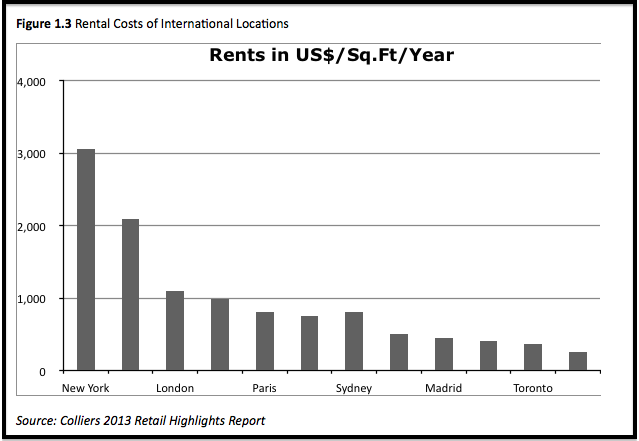
Canada stands to benefit as rents on Canada’s best retail streets are some of the lowest to be found on the global market. Table 1.3, to the right, provides a list of cities with their corresponding rents in dollars per square foot per year. As one may expect, New York and Hong Kong are the most expensive cities in the world to rent retail space. Canadian average rents per square foot range from between $200-$315 in Vancouver (Robson Street) and Toronto (Bloor Street West), or about $200,000-315,000 per annum for a space of 1,000 square feet. By comparison, the same space on New York’s Fifth Avenue would cost upwards of $3 million. This means that, all things being equal, the rental costs per square foot for retail space in New York’s best area is as much as 10 times that of Toronto or Vancouver. Many retailers correlate the rental costs to the average expected sales per square foot. However, recent data in Canadian retail sales seems to point to an opposite conclusion, namely, that Canadian stores not only cost less but also generate strong revenue relative to that cost.
Conclusion
Launching new stores is an expensive endeavour for global brands. The total fixed costs of rents for the top stores can have a huge impact on annual profitability. With more and more brands slated to open in Canada, it appears that Canada holds tremendous potential. There are a number of reasons why Canada is quickly becoming a hot spot for global expansion, a high per capita gross domestic product, purchasing power and Canadians appetite for all things fashionable. All these factors are important and play a role in the decision making process. Canada’s attractive rents, which decrease the fixed costs required to generate potential sales, should be central to any discussions about global brands deciding to call Canada home.

Nima Ghodratpour is an MBA candidate at Queen’s University with over 11 years of Canadian and International Luxury retail experience, working for Clinique, Bloomingdale’s and Boutique 1. Nima can be contacted at linkedin.com/in/nimaghodratpour.





Really? You can’t compare Robson street to 5th avenue. They are not even remotely similar based on traffic, draw, spending potential, brand awareness value… Compare Mall of America to West Ed or something. You’ll still find when you compare traffic densities and population factors that rent is very similar… In the range of 15-20% of sales.