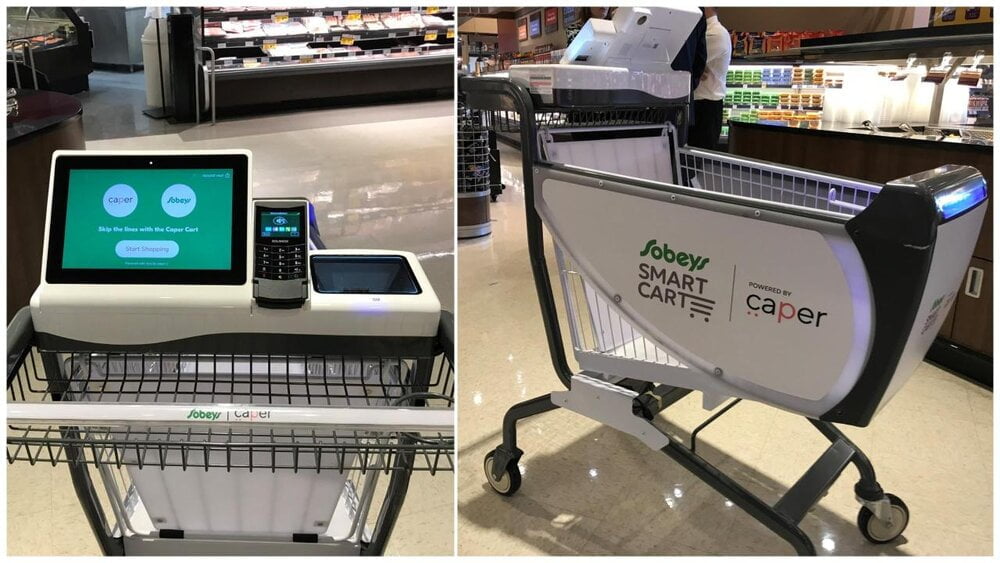
Grocery giant Sobeys unveiled what it calls Canada’s first ever “smart” shopping cart at a store in Oakville, Ontario.
Sobeys has partnered with U.S.-based Caper for this pilot. Essentially, the cart you pick up as you enter the store will have high-tech devices attached to it. These devices will allow customers to shop, get recipe ideas, obtain information on where to get ingredients, weigh and pay for their food. It has a built-in GPS so you can find whatever you need in the store. Great idea for people looking for some assistance and who want to be on their way as soon as they can. The “smart cart” has been developed to enable shoppers to bypass traditional checkout lanes, one of the most unpleasant moments for any grocery shopper. The shopping cart helps you to pay without dealing with lineups and cashiers. Your cart is your friend, your shopping buddy, if you will.
Most have talked about Amazon Go’s model, a cashier-less store with millions of sensors allowing you to pick, choose the products you need, and walk away. The money is automatically withdrawn from your bank account, as a pre-registered shopper. Amazon is currently opening as many as 3,000 new AmazonGo cashier-less stores over the next few years. To put things into perspective, Ontario has about 5,500 grocery stores, so this movement toward a cashier-less industry is real.
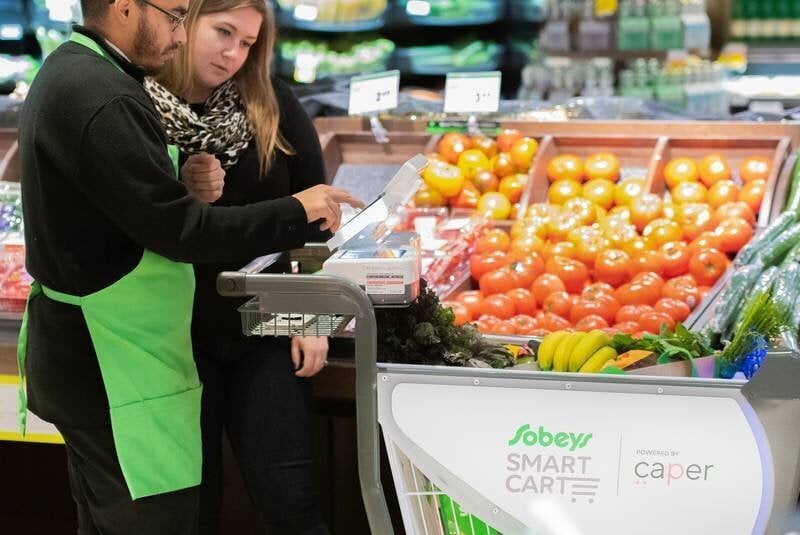
Caper, an artificial intelligence (AI) company, has a different spin to a futuristic cashier-less world. Instead of installing all kinds of high-tech cameras and sensors in ceilings and on shelves, all that purchasing automation is part of the grocery cart itself. The cost to equip a store with multiple sensors can be prohibitive, especially for a low-margin industry like the grocery business. The smart cart allows the legacy of a brick-and-motor outfit to adopt state-of-the-art technology without any costly adjustments to its infrastructure. This makes Caper’s value proposition for grocers quite attractive, but time will only tell if consumers are willing to embrace a model which requires little or no human interaction. Zero.
The intrusion of all these new technologies have made some uneasy. Consumer-focused AI, or in-store customer experience technologies, are slowly becoming a disruptive force within the food industry, as we have seen in other sectors of our economy. Technology is replacing humans. AI is slowly taking its place in our lives to serve us, to make our economy more robust. However, whether these technologies will allow grocers to generate more revenues remains to be seen. Monetizing convenience is not easy in this sector. If not, these measures are all about cutting costs, labour-costs specifically.
The rise of automation and its supplanting of jobs done by people has increased over the years, and a number of these positions are female-dominated roles. Legal frameworks have barely looked at how technological-enabling features impact the food industry, let alone society in general. The socioeconomics of these technologies should also be considered. Almost one million Canadians have no bank accounts or credit cards, making a smart cart a nonstarter for many Canadians. A cashless economy could be deemed discriminatory, which is why grocers are considering AI-enabling technologies with extreme caution. Sobeys’ initiative is indeed a pilot. Some legal cases are arising in the U.S. right now.
History has shown that AI will not completely replace people but it will amend peoples roles so that they can devote more time developing strategy, getting new leads, and building relationships with vendors. There is currently a huge strategic deficit in the grocery sector. Most of us wouldn’t see it, but experts and industry dealers are the first one to admit it. AI will enable retailers to better understand consumer psychology by helping industry to better understand how the human brain is thinking at any given moment. In turn, inventory management can be greatly enhanced. Unlike Amazon, the grocery sector was never good at it. Now, it’s playing catch-up.
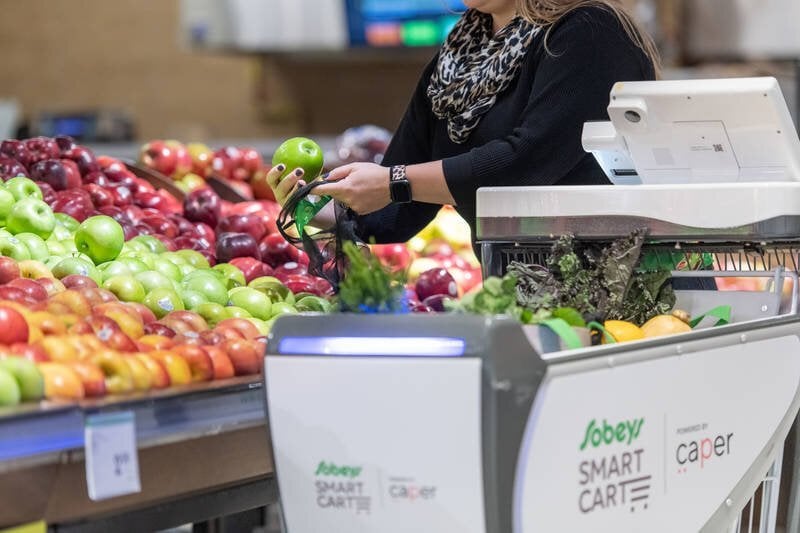
However, for grocers these days, hiring people is hellish. Finding people to work in a grocery store can be a challenge. The challenge for food retailers is to hire and retain personnel while offering a great grocery experience to consumers. Self-checkout lanes made their way into grocery stores almost 20 years ago. Even if the usage rate of self-checkouts in grocery stores in Canada has increased by 17% this past year alone, some work is required by consumers. Many have wondered whether patrons themselves should be compensated for work which was traditionally done by a store employee.
What Sobeys and Caper are proposing has none of that baggage. The consumer’s role doesn’t really change if the technology works and offers a frictionless experience. It’s a step forward, but our path to more AI in grocery retail will remain challenging for a while. Yet there will be a day when most of us will grocery shop without talking to anyone.