
In an announcement on social media this week, Miniso Canada announced that its Chinese parent company has taken over the Canadian operations. This follows a tumultuous time in the company after the Chinese parent company applied in the courts to bankrupt the Canadian division amid claims of fraud.
A statement on Miniso’s Instagram account said, “Miniso China and Miniso Canada are pleased to confirm that we have reached a definitive agreement, under which Miniso China will take over the operations of the Miniso stores in Canada, while advancing to take over the ownership of these Canadian stores.”
This is good news for Miniso fans in Canada, as there was a threat in December of 2018 that Miniso’s entire Canadian division could have shuttered. Miniso’s Chinese parent company applied in a Vancouver court to place the Canadian division into bankruptcy. We discussed the situation extensively when we were first to report on the court filings, as well as when we followed up on the matter after companies announced that there was an initial agreement.
In early January of this year, an interim agreement was reached between the two companies. John Grieve, a lawyer with Fasken in Vancouver who represents Miniso Canada’s parent company Miniso Guangzhou LLC, told the Canadian Press in a statement that instead of heading to court, Miniso Guangzhou LLC and its Canadian franchisee have reached an interim agreement.
That agreement involved Miniso keeping its Canadian stores operating while at the same time delivering inventory to Canadian operations while both sides “work towards a long-term solution”. That solution appears to involve the Chinese parent company taking over the Canadian operations entirely — sources inside Miniso Canada told us that the Canadian launch was one of the most successful in the company’s history, and that the Canadian division was a top performer for the chain. It’s a remarkable claim, considering that Miniso entered Canada in 2017.
In December, Miniso’s Chinese parent company, Miniso Guangzhou LLC, filed to bankrupt Miniso’s Canadian operations after claims that the Canadian division was acting fraudulently with such activities as disposing of inventory, transferring registered trademark rights to third-party corporations, and not meeting liabilities when due.
In the filings, Miniso’s Chinese parent company claimed that Miniso’s Canadian division owed about $2.4-million in loans as well as about $13.3-million in inventory (both in US dollars).
On December 17 of last year, Miniso issued a statement claiming that it has reached a preliminary agreement, after we broke the story of the lawsuit where the Chinese parent company said that it wanted the Canadian operations to be taken over by a trustee.
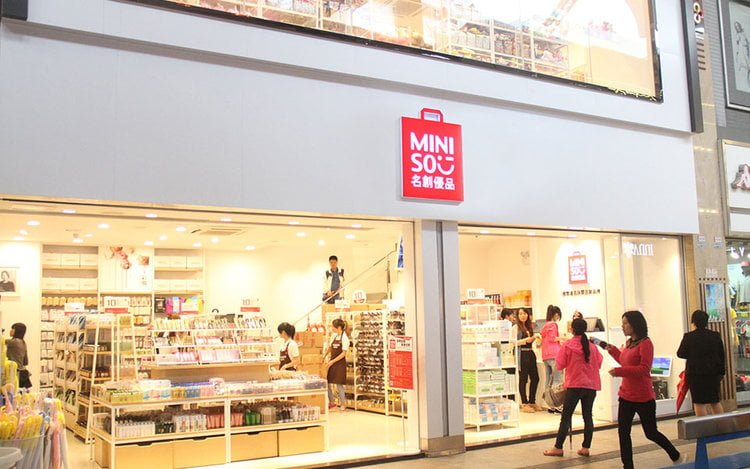
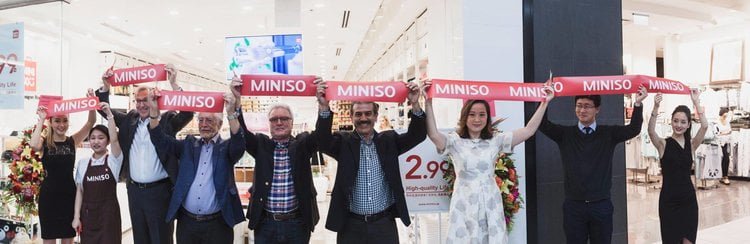
Miniso opened its first Canadian store in Vancouver in the spring of 2017, and it now operates more than 50 stores in the provinces of British Columbia, Alberta, Ontario, Quebec and Nova Scotia. In 2017 in an interview, the company told Retail Insider that it planned to open 500 stores in Canada within three years, which could possibly be the most audacious expansion announcement for a retailer in Canadian history.
Miniso was somewhat controversial from the outset of its Canadian expansion. The company calls itself a ‘Japanese lifestyle brand’ although it is headquartered in China, and its branding and stores copy elements from retailers such as Uniqlo and Muji. Some even claim that Miniso’s Japanese co-founder was hired as an actor in order to align with the brand’s ‘Japanese’ positioning. Miniso is a value-priced retailer that offers a range of about 2,500 branded SKU’s such as electronics, clothing, toys, underwear and other accessories, with prices between $2.99 and $34.99.
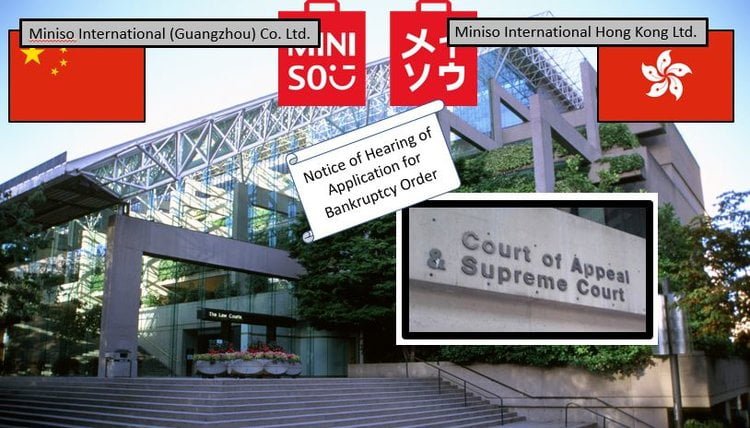
On December 12, parent company Miniso International Hong Kong Ltd. and Miniso International (Guangzhou) Co. Ltd. filed an Application for Bankruptcy Order in the Supreme Court of British Columbia. A Notice of Hearing of Application for Bankruptcy Order was proposed to be held at the Vancouver Courthouse on January 7 and while it was on the court docket, the matter was mutually settled.
The Chinese parent company claimed in the original Application that the Canadian division has “committed acts of bankruptcy within the six months preceding” and that Miniso Canada had, “in Canada, made a fraudulent gift, delivery or transfer of the Debtor’s property, or part of it”.
The parent company claimed in the Application that Miniso Canada transferred or “made a gift of inventory” that was provided by the parent company to the Migu Store Corporations. The Application also claimed that Miniso Canada has “assigned, removed, secreted or disposed” of the parent company’s property with the intent to “defraud, defeat or delay its creditors” by “assigning ‘or disposing” of inventory to Migu Store Corporations.
The Application claimed that the Canadian division transferred the intellectual property rights of Miniso Canada to the Migu Store Corporations that was “in a manner contrary to the terms of the Licensee Agreement” and as a result, “the Migu Store Corporations are misusing the IP rights to the detriment” of the parent company’s brand and registered trade-mark. As well, it appeared that the parent company may have terminated the rights for Miniso Canada to use the Miniso trade-mark in this country, though stores and branding remained in place throughout the ordeal.
We spoke to multiple sources before and after the application, and we were provided some concerning information. One source said that Miniso had been unethical when dealing with some commercial real estate brokers. Another source claimed that Miniso Canada induced highly skilled retail professionals to leave secure employment in order to launch Miniso in a new province and within six months of establishing several stores in the province, the retail professional’s employment would be promptly terminated so that the local licensee could take over the thriving operations. The ownership arrangement of Miniso Canada involved the Canadian division initially owning a slight majority of the provincial franchise for Miniso and after opening several stores, the local partner would gain a majority share in order to continue with the operations.
The rapid expansion resulted in long hours for employees, weekend work and overtime, with some staff spending nights in sleeping bags in a company warehouse.
Miniso could still be in trouble particularly in Quebec, as well, where it has not met language standards that include french language on products and overall branding. One former employee explained how Miniso had been put on notice by the Office québécois de la langue française, or the ‘Language Police’ as some call them. Multiple lawsuits for unpaid construction projects also plague the retailer.
The language issue could result in Miniso losing millions of dollars if the ‘Language Police’ follow through with threats to fine Miniso. Fines can be steep, with a maximum fine being $20,000. According to law firm Blakes, if a business is put on notice and doesn’t adhere to language laws, there “is the possibility that an additional fine may be imposed on the offender equal to the financial gain the offender realized or derived from the offence”.
There are several pending lawsuits from companies that claim to have not been paid by Miniso Canada, including construction companies that built some of its stores. Court filings are public record in most provinces, and some are searchable online.
Ultimately, the announcement that Miniso’s Chinese parent company is taking over the Canadian division is a good one. The company’s overall concept is exceptional, offering a variety of inexpensive items that are well-designed, in store environments that are bright and upbeat.
The company continues to expand to this day, including in some high-profile locations. Miniso will soon open a storefront at the base of the ‘Smart House’ condominium building at 215 Queen Street West in downtown Toronto.
The retailer will occupy more than half of the commercial podium of the recently completed tower, which is steps away from the Osgoode TTC Subway Station. Across the street, Toronto’s first approved legal cannabis dispensary, named Hunny Pot Canabis Co., will open at 202 Queen Street West.
Stores also appear to be stocked. A recent visit to a Miniso store at Vaughan Mills, north of Toronto, revealed a well-stocked store with thousands of items. Hopefully the retailer can continue on its path to a goal of opening 500 Canadian stores, amid what may have been only a temporary setback.