Thefts Increase in Retailers in Canada that Remain Open During COVID-19 Pandemic: Expert

Date:

Share post:

As the shopping sources have narrowed in this COVID-19 pandemic, so too has the supply chain for shop thieves, says retail security expert Stephen O’Keefe.

“Criminality tends to migrate, and in this case, retailers who are open to supply the essential such as grocery and medication, have been hit hardest because the market is small,” said O’Keefe, a Toronto-based veteran of the retail industry and President of Bottom Line Matters, a web-based loss prevention and risk management solutions company for small to mid-sized retailers.

O’Keefe said there is a group of people out there that thrive on crime. It’s their job. It’s their livelihood. They pay their rent and bills through the proceeds of crime – the cash that they get.

“Just as anybody else they look to the marketplace. Where am I going to get that next paycheque if I’m laid off? Or where am I going to get that next toilet paper roll if I’m shopping for groceries? So you hoard. It’s this human nature thing. You look and say where is my future food going to come from?,” said O’Keefe.
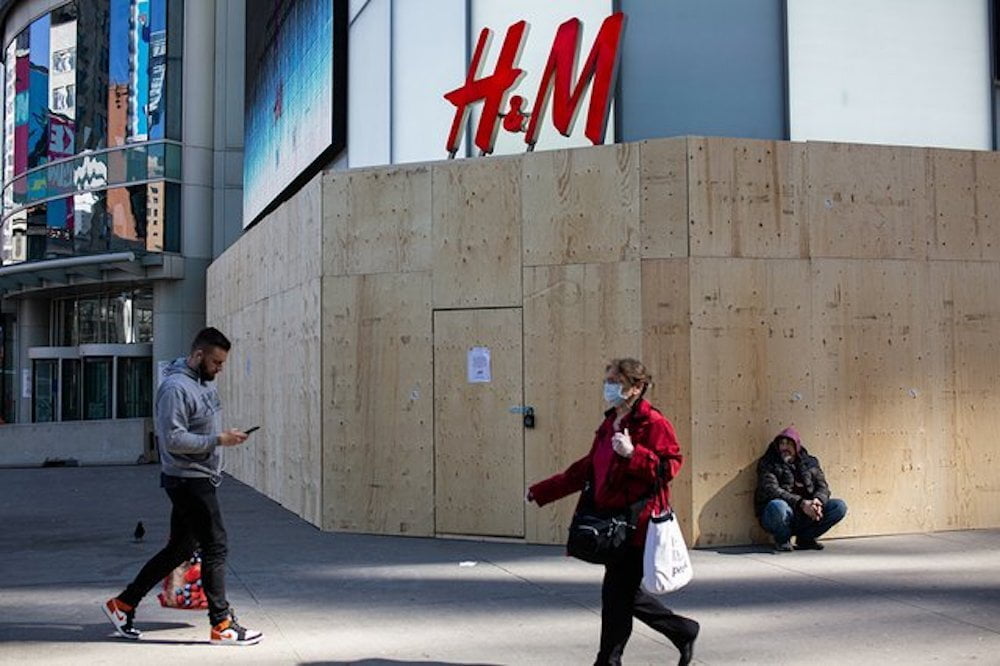
A BOARDED UP H&M AT THE CF TORONTO EATON CENTRE. PHOTO: NOW MAGAZINE

“So what’s been happening is we’ve shut the door because we’ve literally shuttered the doors of a lot of retail businesses. So these guys who are shoplifters who might steal let’s say $200 to $300 a day and convert it to cash somehow, and it’s kind of this normal thing that they do, now don’t have access because a lot of the stores that sell the non-essential things have shut their doors.

“These shoplifters now are wondering what they are going to sell to their market which is people who are re-selling or the people who are buying stolen goods and giving this shoplifter cash. So they look to other ways and other activity and what they’re finding is the grocery stores are experiencing more of it. It’s not that there are more shoplifters. It’s that the market itself, the supply chain, has narrowed. They’re going after these retailers that they normally never hit.”

Customer service is critical at this time for retailers. Employees need to make sure they are aware of who their customers are in the store and what they are doing.

O’Keefe said criminals involved in organized crime have to feed their supply chain and have become more brazen, even moving into the robbery and break and enter category.

There have been a number of cases across Canada where retail stores, who have temporarily closed their doors through this crisis, have been hit.

“Break-ins have gone up everywhere. But there are things retailers can do to protect themselves,” said O’Keefe.

“Risk of exposure is still the number one deterrent to the majority of criminals. Retailers must find what works for them to maintain this measure at a social distance. This includes cameras, and security guards, but should also involve a buddy system. The way this works for independent businesses is the same way it works for neighbours. Let your buddy know when you are around and not around, and even take turns watching out for one another.

“Limit the assets if you plan to be away for a while, and notify the potential thief. Let them know there is nothing to steal through signage. If you have empty registers, keep them open if they are visible from a window. Thieves do their homework, and an empty register is a waste of time and effort for them, and the risk of being charged with a B&E is still the same if the register is full or empty, so let them know the risk isn't worth the reward.”

O’Keefe was Walmart Canada’s VP Loss Prevention & Risk Management for 15 years. He currently advises on loss prevention affecting shrinkage and profitability for retailers and has more than 30 years experience in retail theft prevention with some of Canada’s largest retailers. He is considered a leading authority on loss prevention, security, risk management, health and safety and process improvement.

SOME LUXURY STORES ON BLOOR STREET BOARDED UP TO PREVENT THEFT. PHOTOS: CRAIG PATTERSON

Before establishing his own consultancy firm, O’Keefe held a variety of loss prevention management positions with Sears Canada, Zellers, The Hudson's Bay Company, and Walmart Canada.

In 2016, he was awarded the Retail Council of Canada’s Loss Prevention Lifetime Achievement Award.

“The key is retailers have presented a risk of exposure to somebody considering doing something dishonest against them. That’s the key to loss prevention. I know my company name is Bottom Line Matters but that’s the bottom line. It really is. The bottom line is you have to present a risk of exposure because anybody who is doing a crime is going to evaluate risk reward. When they look at the risk side, they consider the reward . . . but when they evaluate the risk part they look at whether they are going to be seen, observed, caught,” he said.

Because of the coronavirus, there are less people out and about and less risk of exposure so the retailers really need to consider the things they can do from their business to put in that risk of exposure.

“I am shocked that camera sales for security companies have not gone through the roof because the first thing I would do is put extra cameras everywhere,” he said.

“Social distancing does not mean that you have to be absent.”

RELATED ARTICLES

Subscribe to the Newsletter

Subscribe

* indicates required

RECENT articles

Bento launches Nashville hot chicken sushi roll across Canada

Bento’s latest sushi product combines Nashville hot chicken with traditional roll ingredients and will be sold at participating Canadian grocery, retail and post-secondary locations.

Aritzia’s Stronger Store Performance Supports Continued North American Expansion

Aritzia is reporting stronger boutique productivity and customer traffic as it expands across North America. The Vancouver-based fashion retailer plans additional U.S. openings and repositionings in Quebec and California while continuing to invest in larger stores and digital commerce.

Couche-Tard to acquire Irving Oil retail assets in Quebec, Ontario

The convenience store operator has agreed to acquire retail locations, fuel supply arrangements and cardlock sites in Quebec and Ontario, subject to regulatory approvals.

Toronto Fashion Label Demascaré Expands Into Ready-to-Wear as Shaun Mascarenhas Eyes Retail Growth

Toronto designer Shaun Mascarenhas is expanding Demascaré into ready-to-wear, with local production, selective retail growth and broader ambitions.

Employment falls for 2nd straight month, 68,000 jobs lost in September: Statistics Canada

The unemployment rate increased 0.1 percentage points to 6.5%.

Canadians plan to spend less this holiday season but favour domestic products: PwC

A PwC Canada survey finds 54 per cent of consumers are willing to pay more for Canadian-made goods as planned holiday spending declines 11 per cent.

Maybelline expands mental health campaign to focus on support networks (Video)

Maybelline New York’s latest Brave Together campaign highlights the role of family and friends in mental health support, building on a global program launched in 2020.

Pokémon Card Thefts Push Canadian Retailers to Rethink Store Security

Pokémon card thefts across Canada are prompting retailers to rethink security, insurance, inventory storage and how valuable products are displayed and sold.

Canadians’ confidence in direction of food system weakens: report

A Canadian Centre for Food Integrity survey finds food affordability remains Canadians' top concern as uncertainty about misinformation and artificial intelligence grows.

Montreal’s Transformer Table Reaches $145 Million in Revenue as U.S. Retail Expansion Accelerates

Montreal-founded Transformer Table is expanding its U.S. retail footprint with new microstores and a Maryland flagship as CEO Chris Wantlin discusses the company's revenue growth, retail partnerships and future expansion plans.

Daily Synopsis: October 8, 2026

Holiday spending expected to be down as consumers struggle, Newmarket Walmart closing while Kingston announced, grocery store opens in Winnipeg food desert, T&T opens 1st Ontario cafe, and other news.

Aritzia reports Q2 Fiscal 2027 financial results, net revenue up 44.1% to $1.17 billion

Net revenue in Canada increased 19.8% to $390.4 million, compared to $326.0 million in Q2 2026.

Canada’s Menswear Market Is Being Rebuilt as Retailers Invest in Premium and Luxury

Canada’s premium and luxury menswear market is attracting major investment as Harry Rosen, Holt Renfrew, Simons, independent retailers and global fashion houses expand, renovate and rethink physical retail across Canada, even after the loss of major department-store capacity.

Ralph Lauren Home Joins Maison Territo in Montréal

Maison Territo adds Ralph Lauren Home to its curated catalogue, bringing the American brand’s furniture and distinctive design aesthetic to Montréal.

Casavogue Launches Buy More, Save More Promotion in Montréal

Casavogue’s Buy More, Save More promotion offers $500 in savings for every $3,000 spent on a wide selection of furniture.

Egg Club and Serruya Private Equity Announce Joint Venture to Fuel Global Growth  

New partnership will support expansion of the Toronto-born breakfast brand across North America and international markets.

Kits Eyecare report preliminary Q3 results, substantial growth in total revenue

Total Revenue grew 21.6% year-over-year to approximately $63.7 million, accelerating from 17.8% growth in Q2 2026.

Canadian Shoppers Grow More Selective as Holiday Spending Intentions Weaken

A new Stifel survey finds Canadian consumers entering the 2026 holiday season with weaker spending conviction. Holiday budget intentions fell sharply, while value retail remains resilient and higher-income shoppers show growing caution across several discretionary categories.

Selwyn Crittendon moving on to different role at IKEA

He will remain with IKEA Canada until December 31, and the company expects to announce a successor in the coming months.

Scarce Retail Space Gives Canadian Landlords New Leverage

Canada’s tight retail real estate market is shifting negotiating power toward landlords as limited construction and high occupancy constrain available space. JLL, Primaris, RioCan, McDonald’s and Empire executives discuss the implications, including the temporary opportunity created by former Hudson’s Bay locations.