By: Vladi Shunturov, VP Product – Retail IoT Solutions, Acuity Brands Lighting
COVID-19 has changed (and will continue to change) the way consumers shop in stores and what they elect to purchase and prioritize. When COVID-19 guidelines were enacted, essential retailers had to quickly adapt operations to comply with social distancing regulations. Retailers who had the availability of real-time location data were able to monitor shopping patterns to gain insight into how they can better meet new COVID-19 safety requirements while adapting to what consumers want during this pandemic.
Anonymized and aggregated data from five large North American retailers show a shift in the average shopper journey from mid-March, when shelter-in-place restrictions began to take effect. The data shows a combined 44% increase in paper products, household products and dry goods. At the same time, the data reported a combined almost 50% decrease in shopping for clothes and shoes. The data also showed an 11% increase in traffic to brick and mortar locations during the week of March 9 -16, 2020. From this analysis, it can be easily seen that consumers began stocking up on essential goods as soon as the call for shelter-in-place was made.
Location data helps keep up with changes in shopper habits
An Internet of Things (IoT) sensory network of intelligent lighting installed in stores enables retailers to analyze and take action on the movement and utilization patterns of carts and baskets as they move through the store. The anonymized and aggregated heat maps below show shopper traffic before and after shelter-in-place announcements were communicated.
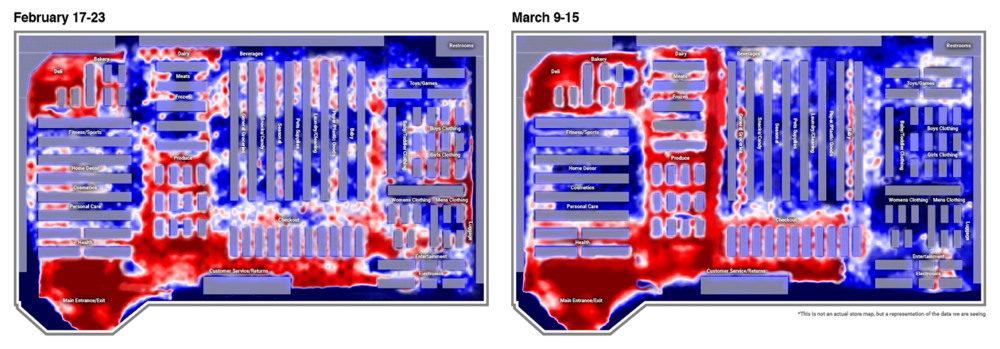
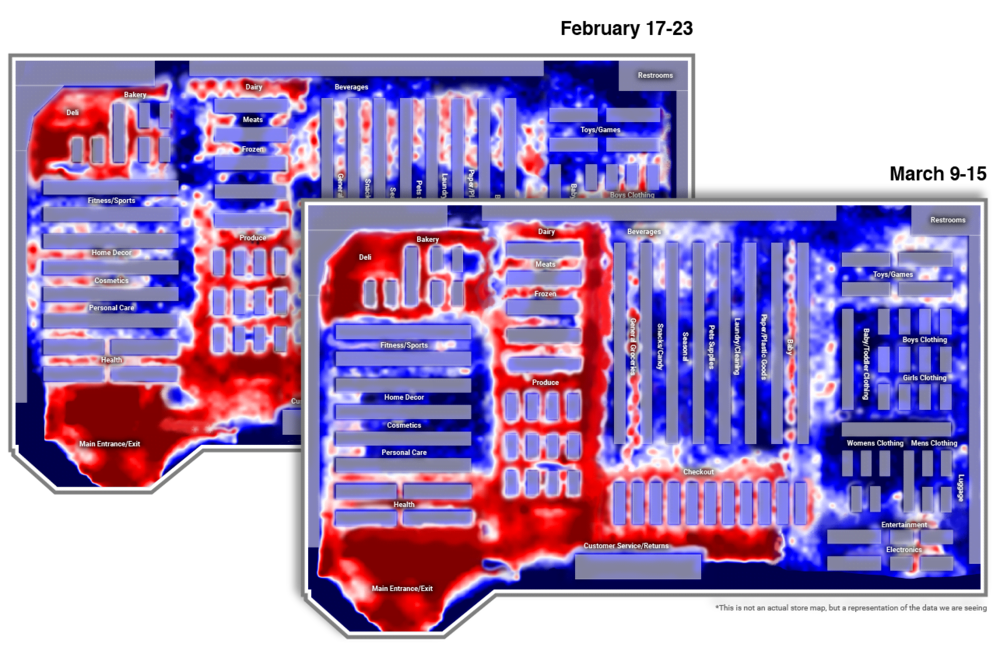
On the left, the heat map shows relatively normal shopping behaviour for the week of February 17, with traffic dispersed throughout the store. Fast-forward a few weeks to March 11, when WHO declared COVID-19 a global pandemic and the traffic patterns shift dramatically in the same store. As the heat map on the right indicates, shoppers were dwelling almost exclusively around essential goods: grocery, health, household, and baby supplies (formula, diapers, wipes, etc.).
What can retailers do with this information?
Utilizing real-time location data allows retailers to see shopping patterns so they can adapt resources such as where and how to staff employees, what products and/or aisles need to be restocked and how to prepare for peak shopping hours. Additionally, they can use the data to capture the most stagnant times and allocate those time frames for the “at-risk” demographics to shop.
Use data to inform store design in a crisis
Stores can use shopper journey, dwell, and behaviour trend data from this pandemic to retrofit low-traffic departments (e.g., apparel in these examples), to disburse high-demand items. The insights from this data can help retailers create more space for shoppers who are buying in-demand items and can also support social distancing mandates.
Improve Buy Online Pickup in Store (BOPIS) operations
Since Canada clarified the list of essential businesses, many non-essential retailers have seen their businesses transform from receiving only a couple dozen BOPIS orders a day, to quickly having BOPIS orders becoming the only way to enable sales. Mobile wayfinding technology can help new and/or temporary employees find items faster and be more efficient to serve consumers in this new way. IoT sensory networks and location services greatly simplify the common challenges associated with order fulfillment and product search.
Shopper analytics data gives retailers the knowledge required for strategic decisions which can help address associate safety during COVID-19. Detailed understanding of stores and zones with incidence of congestion allows retailers to take immediate action, implement new protocols in near real-time and ensure compliance with local safety regulations.
As retailers prepare for the prolonged effects of COVID-19 on shopper behaviour, adoption of tools and technologies can provide real-time operational insights across a series of store locations. These insights can help a retailer improve customer experience and implementation of safety guidelines while helping to protect their store’s bottom line.

Vladi is a founder, product leader and innovator in the IoT, data analytics and connected buildings space. He is passionate about solving complex problems using data and building cloud-first solutions with a great user experience. Vladi serves as VP of Product for Atrius - Acuity’s Connected Lighting and Indoor Positioning technology business unit. He was also a co-founder and CTO of Lucid (acquired by Acuity Brands in 2018), maker of BuildingOS - a connected buildings cloud platform used by Facility, Energy and Sustainability management professionals across 500+ enterprise customers and 25,000 commercial buildings to centralize all building operations data (utility, meter, BMS, IoT, asset & maintenance). He is the recipient of numerous industry awards including from the U.S. EPA and the Cleantech Open. He has previously been invited to speak and share his expertise at Autodesk University, CoRE Tech, DisruptCRE, the EPA and DOE, Greenbuild, and at TEDx.