By Ani Nersessian
Recently businesses and customers have both learned a lesson in just how critical it is for businesses to both be virtually present and fully operational. When consumers are stuck at home — no matter what the reason — they depend on the accessibility of online shopping. While the default source is often Amazon, there are several ways that smaller businesses can compete: social calls to action, quality assurance, competitive delivery timelines, unique product offerings, and ease of shopping. Most of these selling points can automatically be showcased in a business just by highlighting that the business is a local business.
Many social calls to action have emerged this year as our society tackles several dilemmas. One of them is the concern for the pandemic’s impact on the economy and our citizens’ livelihoods. It is completely understandable that our community has been asking to shop local for this very reason. Just as any time is a good time to boast about local relevance, it is important for businesses to highlight whether they are a small or local business to prompt the current community support.
Another reason to highlight locally-based businesses is that it often equates to higher quality assurance. Whether the products’ origin or the retailer itself is locally based, it often equates to higher quality, or at the very minimum, an easier return process to fall back on. The convenience of local also typically suggested shorter delivery timelines and lower fees, which is a huge competitive win during periods when many deliveries are delayed.
Product offering is a huge selling factor, particularly when setting yourself apart from large businesses with high inventory by offering a more curated experience. Sometimes consumers do not know what they need to search for. For example, they may be searching for a gift, but do not have any specific ideas in mind. Special product offerings to help inspire purchase decisions would be very beneficial in these cases. Knowing how to present these product offerings without overwhelming the consumers falls within the scope of successful merchandising.

IMAGE OF PERSON NAVIGATING SHOPIFY ON THEIR LAPTOP. IMAGE OF AN ASSORTMENT OF ACCESSORIES.
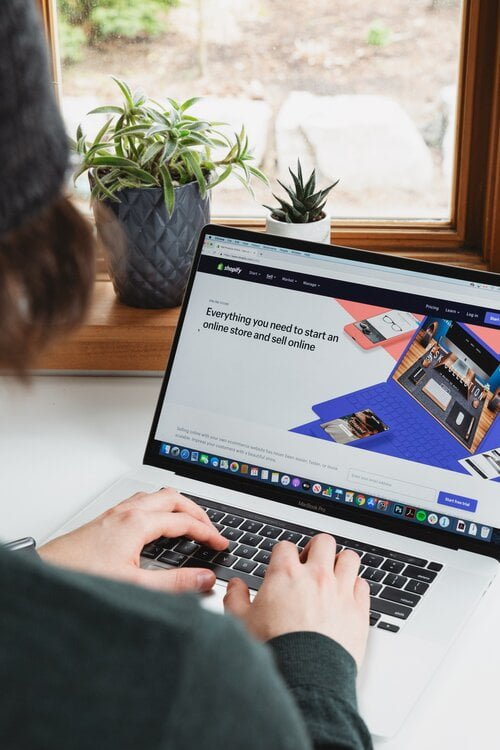

The ease of shopping is the most important factor when strategizing how to create a positive shopping experience, beginning with sparking the temptation to shop, effective communication so that the customer can shop independently and continue adding to their carts, finalizing with a smooth experience to the cash out point. This is already directly affected by digital merchandising.
To optimize digital merchandising and leverage off e-commerce platforms, businesses need to focus on their introductory message, product adjacencies, ease of browsing, and be aware of their competitors’ online position as well.
OVERALL IMAGE: How professional does the site seem? Website design needs appear professional for a brand to also seem credible and established.
INTRODUCTORY MESSAGE: The current, most relevant collection or campaign needs to be introduced immediately. Similar to the concept of a window display, the primary reason to buy needs to be shown within the first view of the web site. This may be in regards to product relevance such as showcasing masks, comfy home wear, activities for kids etc. What needs do customers likely have in their lives at the moment? What products could they be searching for to satisfy these needs?
PRODUCT ADJACENCIES: In retail spaces, it is preferable to curate products that would be used together as a means to educate customers, and to entice more purchases per transaction. This is also applicable in e-commerce. While ease of shopping is usually based on correct product categorization (see point below), it is also important to entice product pairings in a way that only cross-merchandising can achieve. This means that when a customer is viewing one product type, their journey doesn’t end there; retailers may consider showing curated collections, as well as “recommended with….” areas.
EASE OF BROWSING: If it’s a struggle, the customer will lose interest and move on. Retailers can absolutely not depend the success of their business on their customers’ loyalty. Therefore, it is important to consider all the ways that customers will want and need to view the products: by product type? By usage? By sizing? The overarching categories should be the most expected ones. However, too much inventory can cause an overwhelming experience, which is when the filtering option is extremely helpful. For example, while shopping for furniture may easily by categorized under rooms or product types, the site may further assist higher inventory circumstances with helpful filtering options that are also based on price, colour, size, shape, and perhaps even material. Tagging products to filter appropriately can be extremely effective in creating an easy and positive shopping experience for online shoppers – this should not be taken for granted. Far too often, we see examples of e-commerce layouts where customers need to know too much of the products beforehand in order to navigate their online shopping journey.
COMPETITOR PRESENCE: When in doubt, retailers should check out their competitors. What is successful or enjoyable about the competitor sites? What disrupts the journey before cashing out? It is advisable to navigate these sites as a customer – not as a business competitor – to truly be productive with critiques. If in doubt, a third party is a good solution to honestly assess how sites compare with others.
There’s no dispute that e-commerce, bricks-and-mortar spaces and/or pop-up spaces all have different roles in serving consumers. Understanding that lighter foot traffic is expected these days, it is imperative to ensure that the e-commerce offering helps to fulfill this gap in business. After all, while other circumstances may not affect an entire society as much as a pandemic, there are various situations in life that would result in needing to stay at home, and this is why catering to an online shopper is always relevant.

After 15+ years of industry experience with various retailers and environments such as Holt Renfrew and Adidas Group Canada, VM ID Inc. was founded by Ani Nersessian to help retailers get set-up with a VM culture that is right for them.
VM ID Inc. is a Visual Merchandising service company which provides catered support for small businesses through consulting, designing and labour services. Email: ani@vm-id.com